Artificial Intelligence

Artificial Intelligence

##Which AI Tools Are Best for Businesses?

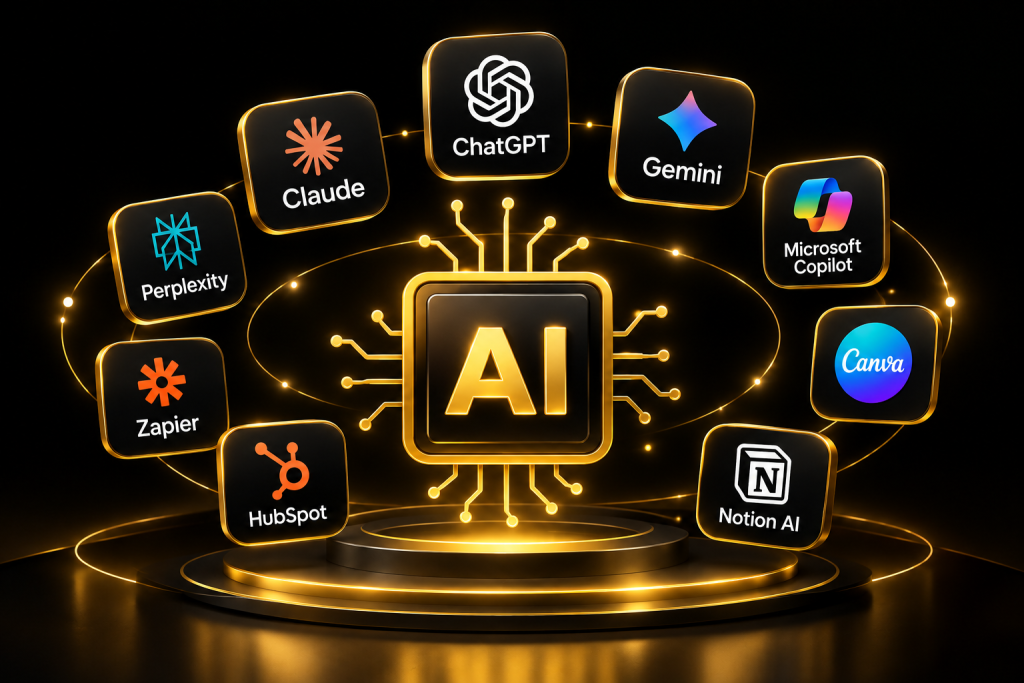
  Artificial intelligence is no longer limited to large technology companies. Today, AI helps businesses of all sizes save time, serve customers better, create content, understand data, and handle repetitive tasks more efficiently.. The right AI tool can act like an extra helping hand, allowing teams to focus more on important business decisions and creative work.   However, there is no single **best AI tool for every business**. The right choice depends on what a company wants to achieve, its budget, team size, and existing software.           ##1. ChatGPT – AI Assistant for Business Tasks  ChatGPT is a versatile AI assistant that helps businesses handle a variety of everyday tasks, including content writing, brainstorming ideas, summarizing information, analyzing data, and drafting professional communication.  **Useful for:**  – Writing emails, blogs, and social media content   – Brainstorming business ideas – Summarizing documents   – Creating reports and proposals   – Analyzing data   – Developing customer -service responses   It is particularly useful for teams that need a flexible AI assistant rather than a tool designed for just one task.   ## 2. Canva – AI-Powered Design and Marketing   Canva combines graphic-design tools with AI features, making it easier for businesses to create professional-looking visual content.  **Useful for:**   – Social media posts   – Presentations   – Advertisements  – Posters and banners   – Marketing materials   – Brand visuals   Even people without advanced design skills can create and edit business graphics quickly.    ## 3. HubSpot – AI-Powered Marketing and CRM   HubSpot combines customer relationship management (CRM), marketing, sales, and customer-service features. Its AI-powered features help businesses create content, manage customer relationships, and streamline everyday workflows more efficiently.   **Useful for:**   – Managing leads   – Customer relationship management – Marketing campaigns – Sales activities – Customer support – Workflow automation   It can be particularly useful when a business wants to keep customer and marketing activities organized in one ecosystem.   ## 4. Grammarly– AI for Business Communication Clear communication matters in every business. Grammarly uses AI to help improve writing, including grammar, clarity, tone, and wording.  **Useful for:**   – Professional emails   – Reports – Website content   – Business proposals – Marketing copy   It can help teams communicate more clearly and consistently.   ## 5. Zapier – Zapier connects different business applications and automates repetitive tasks, helping teams streamline workflows and save valuable time.   For example, a company could connect a lead-generation form with a spreadsheet or CRM so that information is transferred automatically.   **Useful for:**   – Automating repetitive tasks   – Connecting business applications   – Managing leads   – Sending notifications   – Moving information between platforms ## 6. Microsoft Copilot – Workplace Productivity Microsoft Copilot provides AI assistance within Microsoft’s productivity ecosystem, depending on the product and subscription being used.   **Useful for:**   – Drafting documents   – Summarizing information   – Working with spreadsheets – Creating presentations – Improving everyday productivity Businesses already using Microsoft products may find this type of integration useful.   ## 7. QuickBooks – AI-Assisted Financial Management QuickBooks provides accounting and financial management tool with AI powered features   **Useful for:**   – Tracking business finances   – Managing invoices   – Organizing transactions   – Monitoring expenses   – Understanding financial information   AI-assisted accounting can reduce some manual work, although important financial information should still be reviewed carefully.  How to Choose the Right AI Tool  Before choosing an AI tool, businesses should consider their specific needs, goals, budget, and how well the tool fits into their existing workflow.   . ##  Businesses should consider:   **Business goal:**- Identify the specific problem you want AI to solve. **Ease of use:**- Choose a platform your employees can learn without unnecessary complexity. **Pricing:**- Compare free and paid plans according to your actual requirements. **Integration:**- Check whether it works with the software your business already uses.  **Data privacy:**- Understand how the platform handles business and customer information. **Scalability:**- Consider whether the tool can continue supporting the business as it grows.  **Human review:**- Check important AI-generated information before using it for customers or major business decisions. ## Conclusion   AI tools can help businesses work smarter by reducing repetitive tasks and supporting activities such as **marketing, communication, design, customer management, finance, and automation**. The aim should not be to use as many AI tools as possible, but to choose the right tools that genuinely meet your business needs.   Instead, businesses should identify their biggest challenges and choose tools that genuinely solve those problems. Starting with one or two useful tools, measuring their impact, and expanding gradually can be a practical way to introduce AI into everyday business operations.   ## Frequently Asked Questions (FAQ)   ### What Is the Best AI Tool for Businesses?   – There is no universal best tool.   – The right choice depends on the business’s goals, budget, team, and workflow.  – For example, businesses may use ChatGPT for general AI assistance, Canva for design, HubSpot for CRM and marketing, and Zapier for automation.   ### 2. Can small businesses use AI tools?    Yes. Small businesses can use AI tools for content creation, customer communication, marketing, data analysis, graphic design, and workflow automation to improve productivity and save time.   Many platforms offer plans designed for different business sizes.   ### 3. Can AI reduce business costs?  – AI can help businesses save time by automating repetitive tasks and streamlining routine processes.   – It may improve employee productivity and streamline workflows.  – Actual cost savings depend on how effectively the business implements the technology.   ### 4. Is AI safe for business use? – AI can be useful, but businesses should consider privacy, security, accuracy, and access controls.  – Sensitive information should only be entered into platforms after reviewing their data-handling policies.  ### 5. Will AI replace business employees?   – AI can automate certain tasks, but many business activities still require human judgment, creativity, communication, and decision-making.   – In many workplaces, AI is used as a tool to support employees rather than as a complete replacement for them.  Start

Artificial Intelligence

What Is AI?

**Artificial Intelligence (AI)** is a technology that enables computers and machines to learn from information, recognize patterns, understand language, solve problems, and perform tasks that normally require human intelligence. Today, AI is becoming a useful part of everyday life, helping individuals and businesses save time, automate routine work, and make better use of data.   From chatbots and voice assistants to content creation and personalized recommendations, AI is changing the way people interact with technology.      ## What Does AI Mean?   AI allows machines to process information and respond to different situations in ways that can appear intelligent.   In simple terms, AI can help machines:    – Learn from data and previous examples.   – Recognize patterns and relationships.   – Understand and process human language.   – Analyze large amounts of information.   – Create and generate different types of content, including text, images, audio, videos, and other digital materials.   – Make predictions and recommendations.   – Automate repetitive tasks.    – Assist people in solving problems.   For example, when an online platform recommends a video based on your previous activity, AI may be used to identify patterns in your interests and provide relevant suggestions.   ## How Does AI Work?   AI systems work by processing large amounts of data, identifying patterns, and using the information they learn to generate useful results.   A simplified process includes:   ###  1. Data Collection  AI systems use different types of data, such as text, images, numbers, audio, and other relevant information, to learn and perform specific tasks.  Training During the training process, an AI model analyzes large amounts of data and learns patterns, relationships, and useful information from the examples it receives.   ### 3. Pattern Recognition   After training, the system can use what it has learned to analyze new information.   ### 4. Generating Results   The AI then produces an output, such as an answer, recommendation, prediction, summary, or piece of content.   ## Types of AI   ### 1. Narrow AI   **Narrow AI** is designed to perform specific tasks or solve particular problems efficiently.    Examples include:   – Voice assistants   – Recommendation systems   – Spam filters   – Customer-service chatbots   – Image-recognition systems   Most AI applications available today are based on Narrow AI and are designed to perform specific tasks efficiently.  . ### 2. Generative AI   **Generative AI** is a type of artificial intelligence that can create new content, such as text, images, videos, audio, and code, based on user instructions or prompts.   Generative AI can help businesses and individuals with a wide range of tasks, including:   – Writing content   – Brainstorming ideas   – Creating images   – Summarizing information   – Generating code – Developing marketing concepts   ### 3. Artificial General Intelligence   Artificial General Intelligence (AGI) refers to a theoretical form of AI that could perform a broad range of intellectual tasks at a human-like level. It is different from the specialized AI applications commonly used today.   ## Where Is AI Used?   AI is now widely used across various industries and everyday activities.   ###  Businesses can use AI for:   – Customer support   – Data analysis   – Marketing   – Sales forecasting   – Task automation   – Document processing   ### Education   AI can support learning through:   – Personalized explanations   – Research assistance   – Language support   – Practice activities   – Summarizing information   ### Healthcare   AI is being explored and used in areas such as:   – Medical research   – Medical image analysis   – Drug discovery   – Administrative processes   – Data analysis   ###   Digital Marketing AI can help marketers with:   – Content ideas – Audience analysis   – Social media planning   – Advertising support – Customer segmentation – Performance analysis   ## Benefits of AI  AI offers several practical benefits:   – **Saves time: ** AI can automate repetitive activities.    -**Improves productivity: ** It can help people complete certain tasks more efficiently.   – **Handles large amounts of data : ** AI can process and analyze information quickly.     -**Supports creativity:  ** AI can provide ideas, drafts, and content variations. – **Personalization:  ** Businesses can use AI to offer customers personalized recommendations, content, and experiences.    -**Continuous availability:  ** Some AI-powered services can operate around the clock.   ## Limitations of AI   AI is a powerful and useful technology, but it also has limitations and may not always produce accurate or reliable results.   Some important limitations include: – AI can sometimes provide incorrect information.   – 1. Human Review: AI-generated content may require human review, fact-checking, and editing to ensure that it is accurate, relevant, and appropriate.   – Results can depend on the quality of the available data.  – AI systems can reflect biases present in their data or design. – Privacy and security need to be considered when using AI.   – Important decisions should not automatically be left to AI without appropriate human oversight.   ## Conclusion   Artificial Intelligence is transforming the way people use technology by enabling computers and machines to learn from information, recognize patterns, understand language, generate content, and solve different types of problems. From everyday recommendations to business automation and digital marketing, AI has become a valuable technology across many areas. The most effective use of AI is to combine its capabilities with **human creativity, judgment, and expertise  **. When used thoughtfully and responsibly, AI can become a powerful tool for improving productivity and creating new opportunities.     ## Frequently Asked Questions (FAQ)   ### 1. What is AI in simple words?   AI is a technology that enables computers and machines to perform tasks that typically require human-like abilities, such as learning, understanding language, recognizing patterns, and solving problems.   ### 2. What are some common examples of Artificial Intelligence (AI) in everyday life?   Common examples include voice assistants, chatbots, recommendation systems, spam filters, image-recognition tools, and generative AI applications.   ### 3. What is Generative AI?   Generative AI is a type of artificial intelligence that can create new content, including text, images, videos, audio, and code,

Scroll to Top